Imagine yourself in 1965. Freedom Riders, testing segregation laws in the South, were killed and imprisoned just a few years ago. It is just a little over a year since JFK was assassinated. On March 7, Martin Luther King led civil rights marchers from Selma to Montgomery, and they were met with teargas and beatings at the Edmund Pettus Bridge. In August, Congress passed, and President Johnson signed, the Voting Rights Act, which banned the literacy tests and poll taxes that had served as convenient and racially discriminatory barriers to voting. The Vietnam War is expanding and young men are being drafted to fight. Nuclear war seems far too imminent, as the Cold War drags on, and the failed Bay of Pigs invasion is recent history.
It was in this tumultuous year that Connecticut had to establish a new state constitution. A US Supreme Court case had required all states to ensure that political districts had roughly equal numbers of people in them, so that each person’s vote mattered equally: it was known as the “one man, one vote” rule.
Connecticut, like many other states, did not adhere to this standard. Connecticut, formed in the days of small townships, had a “one city, one vote” rule for its House of Representatives, so that each town (large or small) had a single representative (or 2 at most) in the House. By 1965, Connecticut’s industrialization had created huge metro areas alongside the original small townships, yet those big cities still had only one representative in the Connecticut House. People in small towns, therefore, had a much greater voice in state government than people living in big cities.
Connecticut organizations had made attempts to change this form of representation for more than a century – even holding a failed constitutional convention to do so in 1901-02. But now the federal courts were holding Connecticut’s feet to the fire – a new state constitution was required.
What was really wonderful about the 1965 Convention is that despite the fact that the 84 delegates were split 50/50 between the two major political parties, our 1965 founders were able to agree by a 2/3 majority not only on a new plan of legislative representation, but on new constitutional rights of education, freedom of religion, and equal protection. I was impressed with the bipartisanship, responsibility, and integrity of our founding parents – now to include women and many minority groups, like African-Americans and disfavored immigrant communities, that had been formerly excluded from constitution-building in the Constitution State. These 1965 founders included former suffragettes, civil rights leaders, Irish Independence patriots, former governors and judges, WW I veterans, and many other path-breakers and community builders with deep experience and insight.
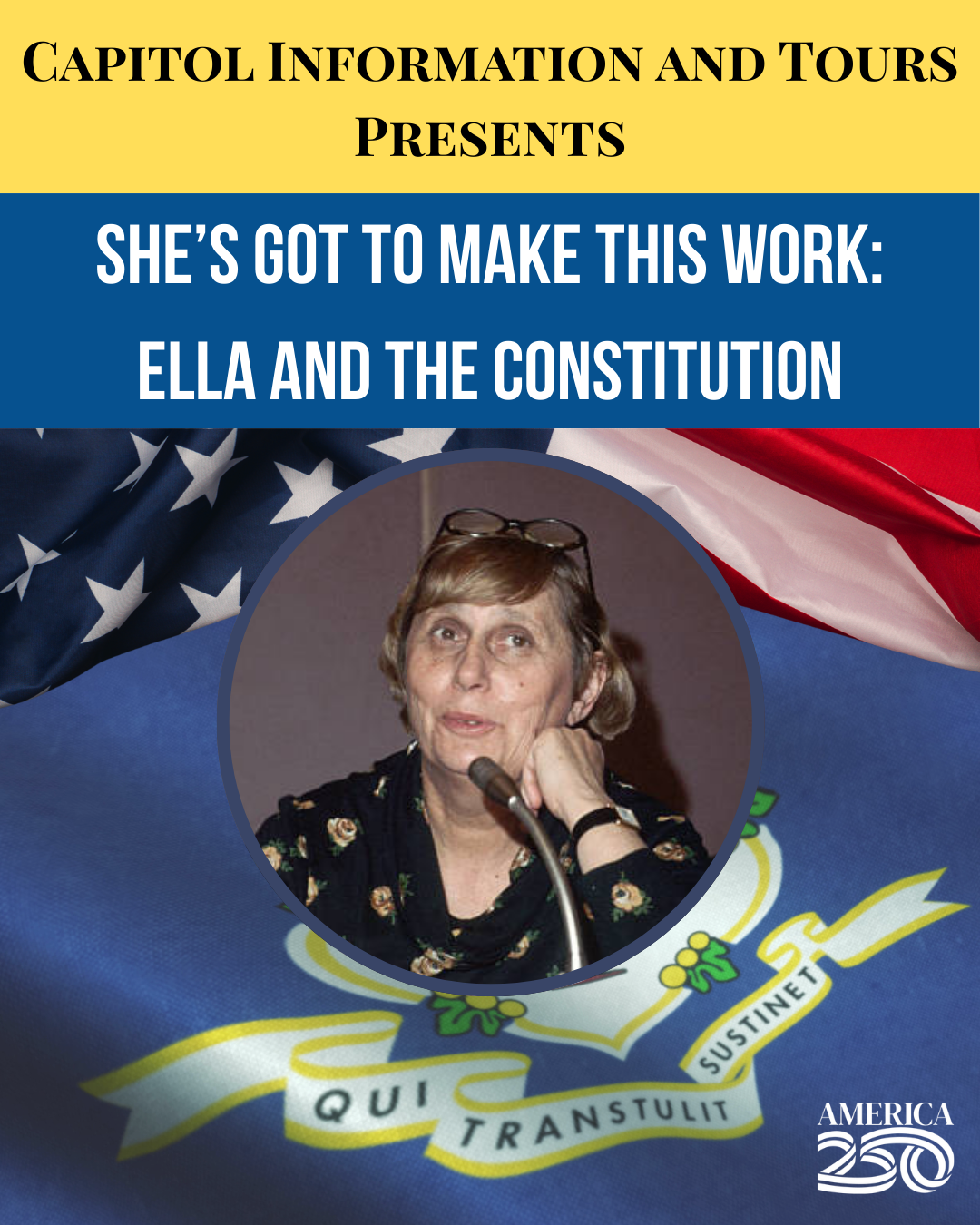
Connecticut’s Ella T. Grasso was Secretary of State in 1965. Could Ella wrangle the delegates to a 2/3 majority agreement? And as I read the words of these founders in the convention transcripts, always human and sometimes humorous, a story began to tell itself, and soon, I heard them sing. So, I decided to write this musical, highly fictionalized, yes, but I hope capturing the spirit of a new founding moment in the chaotic, yet hopeful, Age of Aquarius.
My hope is that it will give us hope, in our own tumultuous time.
—Linda Ross Meyer
Connecticut’s 1965 Constitutional Convention
Contact Us
We would love feedback on this musical-in-progress! Interested in the script or music for educational purposes? Fill out some info and we will be in touch shortly. We can’t wait to hear from you!